



SKILWI has no preference between hiring and upskilling. It weighs all three on your data and picks the option with the strongest business case, whichever it is.
Decision Engine · demo scenarioDrag to explore
Illustrative demo. Explore how SKILWI compares workforce options; a live assessment runs on your workforce and salary data.
Need→Capability→Gap→Options→Economics→Decision
Role you need
How many?
20 people
Reading your workforce…
SKILWI analysis
Hire externally
₹0
—
SKILWI analysis
Upskill internally
₹0
—
SKILWI analysis
Move / redeploy
₹0
—
Cost components
Hire
Upskill
SKILWI reaches
Upskill
Decision confidence High
₹0lower than hiring
SKILWI informs the decision. Leaders make it.
Factors that could change this
⚠ Training completion⚠ Manager capacity⚠ Time-to-productivity⚠ External availability⚠ Attrition in development
Demo scenario on India salary benchmarks (NCO + ESCO + O*NET aligned). Confidence reflects skill-adjacency, cost and readiness evidence, not a probability of business success. Your own run uses your workforce and your salary data. Illustrative model with configurable benchmark assumptions.
HR knows the people. Finance knows the money. Nobody sees the connection.
Headcount, salaries, training spend and performance sit in separate systems. None of them answer what a budget meeting actually asks: what does this workforce decision cost, and is it the right one?
SKILWI connects them.
01Business demand
02Required skills
03Current workforce
04Skill gap
05Hire · Upskill · Move
06Cost, in rupees
07Business decision
No rip-and-replace
Keep your HR stack. Add the intelligence layer.
Your existing systems stay the system of record. SKILWI reads from them and returns decisions, so you add an intelligence layer, not another HRMS.
Your HRMS is the system of record — what happened. SKILWI is the system of decision — what to do next.
DarwinboxKekaGreytHRYour ATSLMSPayroll
↓
SKILWI · Workforce Intelligence
↓
Hire · Upskill · Move, in ₹
Live adapters for GreytHR, Keka and Darwinbox (REST / OAuth2). Start with one decision.
Why the answer is defensible
The graph turns a vague gap into a costed decision.
SKILWI reads business demand as skills, measures your workforce against it, and follows the chain all the way to rupees. The value is the decision chain it enables, not the size of the graph.
01 · Business demand
20 Cloud Engineers
Needed within one quarter.
02 · Role fingerprint
The skills the role really needs
KubernetesAWSTerraformCI/CD
03 · Current workforce
43 employees
carry adjacent skills today.
04 · The gap
18 can close it
4/4 core skills · 2/3 adjacent · seniority met · pathway available
05 · The decision
Upskill 18 · hire 2
where no internal supply exists.
06 · The economics
₹24L vs ₹1.8Cr
build internally vs hire externally.
Underneath: a living skill graph of 28,000+ skills, 349,000+ relationships and 4,454 occupations, crosswalked to NCO, ESCO and O*NET. Current production graph · Aug 2026.
At a glance
Three ways to close the gap, side by side.
The default scenario above, as a scannable comparison. The recommended option is whichever the economics favour, not a fixed preference.
Hire
Upskill
Move
Total cost
₹1.8Cr
₹24L
₹1.2Cr
Time to ready
16 wks
12 wks
6 wks
People available
20
18
7
Skill gap
None
2–3 skills
1–2 skills
Ramp risk
Medium
Low
Low
Backfill risk
—
Medium
High
Illustrative · 20 Cloud Engineers on India benchmarks. Your run uses your own workforce and salary data.
The product
The intelligence, in the actual product.
Real SKILWI screens, doing the work a workforce decision needs.
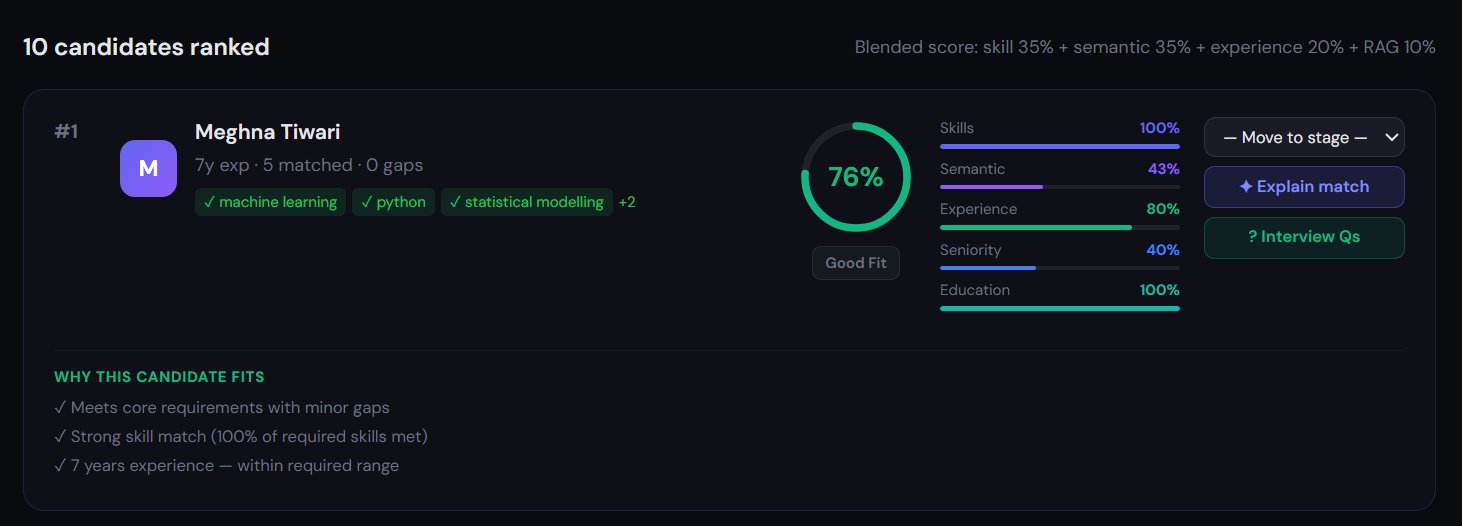
Every candidate is scored against the role's real skill fingerprint on the ESCO + NCO taxonomy, with the reasons for the score, including the gap you'd be hiring, shown up front.
→ Skill, experience, seniority and domain, each explained
→ Ranked by capability, not keyword density
→ DPDP-aligned candidate handling end to end
SKILWI · Candidate matching
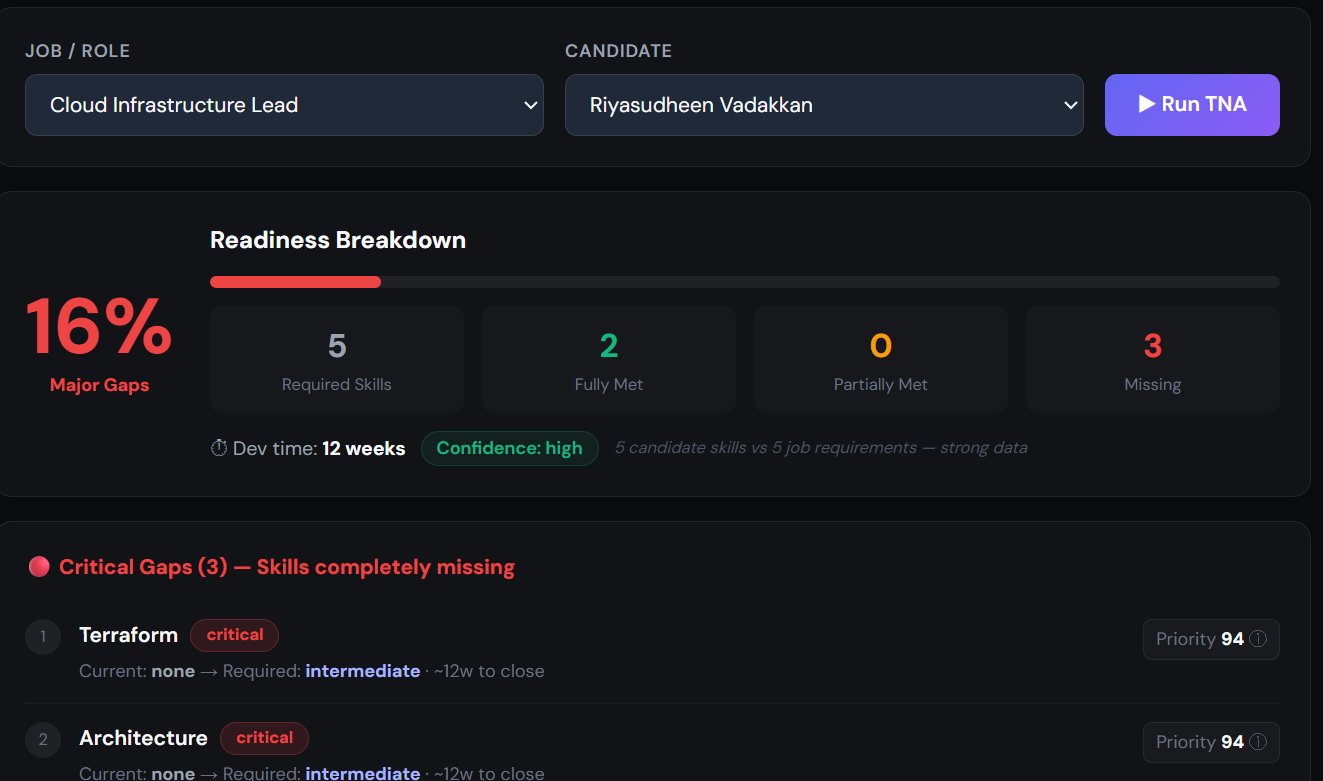
See exactly what it will take to close the gap.
Training Needs Analysis reads the graph and shows where your workforce stands against what each role demands, then sequences the shortest path and prices it, feeding the Decision Engine.
→ Gap by role, department and individual
→ Readiness scored on real skill adjacency
→ Cost to close, in rupees
SKILWI · TNA & readiness
Not a collection of HR tools · one loop
Every decision makes the next one smarter.
Hiring, development and mobility all write back to the same graph, so recommendations sharpen the longer you run on SKILWI.
Skye isn't a chatbot bolted onto HR. It runs the Decision Engine on your live data and shows its working, scoped to who's asking.
Skye drafts. People decide.
✓ Org-scoped, permission-aware answers
✓ Human-in-the-loop before any action
✓ Every AI interaction is auditable
✓ Your workforce data stays inside your tenant boundary
Skye · workforce intelligence
We need 30 data engineers in Bengaluru within 6 months. Should I hire or develop?
Recommendation: Develop 22 · Hire 8
Employees with ≥70% skill adjacency22
Median readiness11 weeks
Development cost₹18.4L
External hiring estimate₹1.12Cr
Positions with insufficient internal supply8
Estimated difference: ₹93.6Ldevelop vs hire all
The India advantage
Workforce economics built for India, not geography.
The answer only holds up on real Indian salary data, real Indian roles and metro premiums that generic benchmarks miss. That's what the engine runs on.
Senior Data EngineerBengaluru · India benchmarks · illustrative
Market rate₹12.7L
Metro premium (Bengaluru)+14%
Internally viable candidates22 of 30
Upskill cost₹18.4L
External hire cost₹1.12Cr
Design partners
Early validation, in the field.
Working with
“The way SKILWI maps candidate skills to job requirements, and explains every score, is unlike anything I’ve used in executive search. Most tools give you a rank. This gives you a reason.”
“Scaling a climate-tech startup in Bangalore, I need to know if I should hire or grow my team, and what it costs either way. SKILWI gives me that answer in rupees, not percentages.”
Early-stage validation with design partners in recruitment, workforce planning and capability development. Quantified case studies forthcoming. Read the Bridgewell case study →
How we think
The Workforce Intelligence library.
The category, in our words. Your HRMS records what happened; workforce intelligence decides what to do next.
Plans from ₹129 / employee / month. Enterprise pricing depends on workforce size, integrations and scope. Full pricing on the pricing page.
What happens after you book
One real decision, start to finish.
01Bring one real workforce decision
02Connect the relevant data
03SKILWI maps the capability gap
04Compare Hire / Upskill / Move
05Get the recommendation & economics
Don’t take our word for the savings. Test it on a decision you already need to make.
Bring us one role you're about to hire.
In 25 minutes we'll run it through the Decision Engine on India benchmarks and show you, on your own workforce, whether to hire, upskill or move, and what each option costs.