How Bridgewell Advisory uses recruitment intelligence in executive search
Bridgewell Advisory partnered with SKILWI.ai to make candidate screening, evaluation, shortlisting and offer-to-joining engagement faster, clearer and more evidence-backed, so recruiters spend less time chasing scattered information and more time advising clients.
 ×
×
 Design Partnership
Executive search depends on speed, judgment, trust and evidence. Every mandate asks recruiters to balance technical capability, leadership potential, culture fit, compensation alignment and candidate commitment. Bridgewell Advisory wanted a platform that supports recruiter expertise rather than replacing it, while giving clients a more transparent basis for every shortlist recommendation.
The challenge
Rankings without reasons
Traditional ATS tools produced candidate scores without explaining the rationale, which weakened client advisory conversations.
Heavy manual screening
Recruiters spent significant time on first-level calls before confirming basic technical and behavioral suitability.
Hard-to-read culture fit
Resumes showed career history but not decision-making style, resilience, team compatibility or role readiness.
Scattered panel feedback
Interview comments and approvals lived across emails, notes and informal chats, slowing final decisions.
Notice-period drop-off risk
Accepted candidates could disengage during 30 to 90 day notice periods, creating last-minute joining risk for clients.
The SKILWI.ai solution
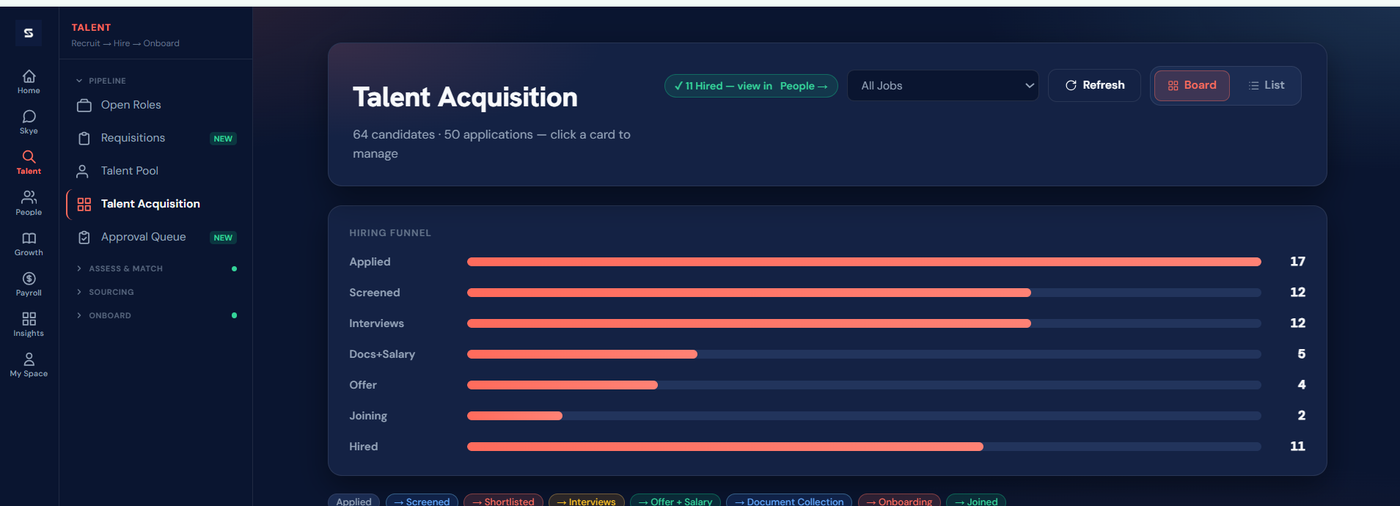
SKILWI.ai introduced a recruitment intelligence layer that connects candidate screening, skill matching, behavioral assessment, panel evaluation, turnaround-time tracking and offer-to-joining engagement into one structured workflow.
- Explainable AI matching. Evaluates candidates across skill match, semantic fit, experience depth, seniority level and educational background, with a written rationale for every score.
- AI video screening. Pre-screens communication, technical relevance and role readiness before manual recruiter calls.
- Consolidated scorecards. Brings interviewer notes, assessment data, salary inputs and Hire, Hold or Pass decisions into one view.
- TAT dashboards. Tracks sourcing, interview and offer-stage delays so bottlenecks can be addressed faster.
- Offer-to-joining tracker. Monitors candidate engagement, resignation proof, silence periods and drop-off risk right up to Day 1.
The intelligence workflow
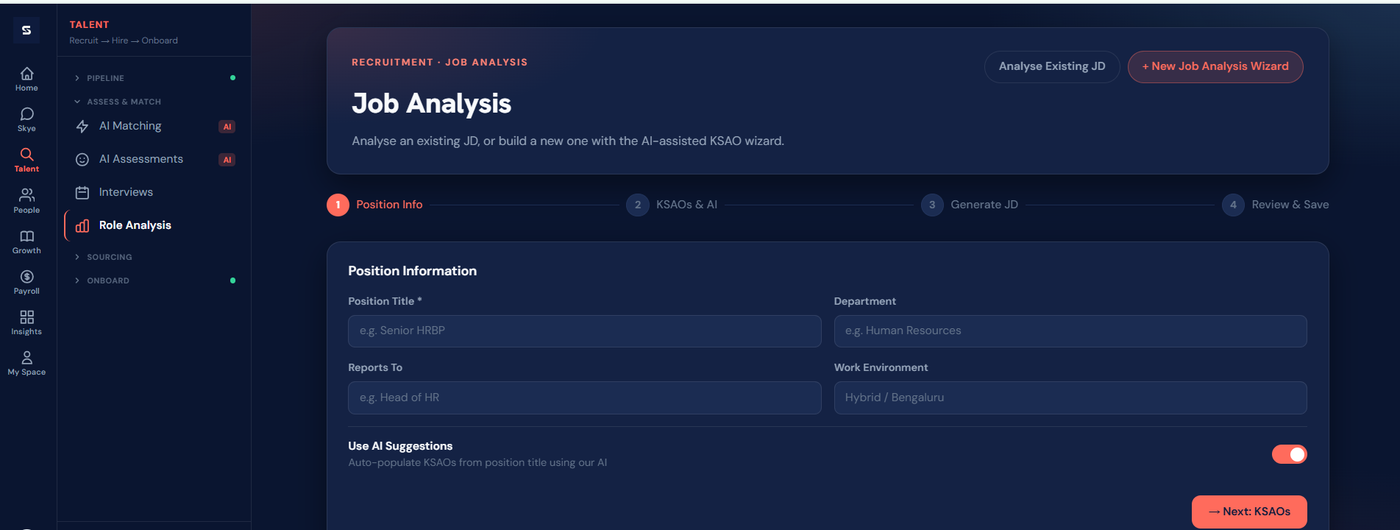
SKILWI.ai runs a closed-loop workflow that connects every stage of the hiring journey, from job requirement analysis to candidate engagement after offer acceptance.
- JD analysis and ESCO skill graphTurns the requirement into a structured, skill-level view of the role.
- 5-signal AI match engineScores candidates on skill match, semantic fit, experience depth, seniority and education.
- AI video screening and behavioral testAutomated pre-screening before recruiter time is spent.
- Candidate scorecard and panel sign-offUnified evaluation with training-need gaps and a Hire, Hold or Pass decision.
- Live TAT and pipeline trackingSourcing, interview and offer stage velocity, with bottlenecks flagged.
- Offer-to-joining "keep warm" trackerRule-based risk monitoring through to Day 1.
Platform capabilities that create value
Consolidated candidate scorecard
The scorecard is the central decision layer for recruiters, interviewers and client stakeholders. Instead of isolated notes or single opinions, Bridgewell Advisory can present a structured view of every candidate across defined evaluation signals.
- Standardized decisions. Blends AI screening, interview ratings, cultural fitment and skill match to reduce single-interviewer bias.
- Targeted upskilling blueprint. Skill-match breakdowns pinpoint specific gaps and estimate training windows, supporting a faster Day 1.
- Streamlined sign-offs. Combines interviewer notes, salary benchmarks (offered versus expected CTC) and the final Hire, Hold or Pass control in one view.
- Auditability and compliance. Keeps feedback structured and auditable while protecting personal data per DPDP norms.
5-signal matching and explainable AI
- Evaluates candidates across skill match, semantic fit, experience depth, seniority level and educational background.
- Generates written rationales for every score, giving recruiters clear reports for hiring clients.
AI video screening and behavioral assessment
- AI video screening reads technical terminology and communication nuance before recruiter phone calls.
- OCEAN and situational-judgment assessment measures workplace decision-making, conflict resolution and stress resilience in a short automated test.
Real-time turnaround-time and bottleneck tracking
Tracks pipeline velocity (total TAT is offer-acceptance date minus requisition-approval date) across three stages:
- Sourcing TAT. Pinpoints weak pipelines or misaligned requirements.
- Interview TAT. Surfaces feedback delays and overbooked hiring-manager schedules.
- Offer TAT. Highlights compensation negotiation and internal approval holds.
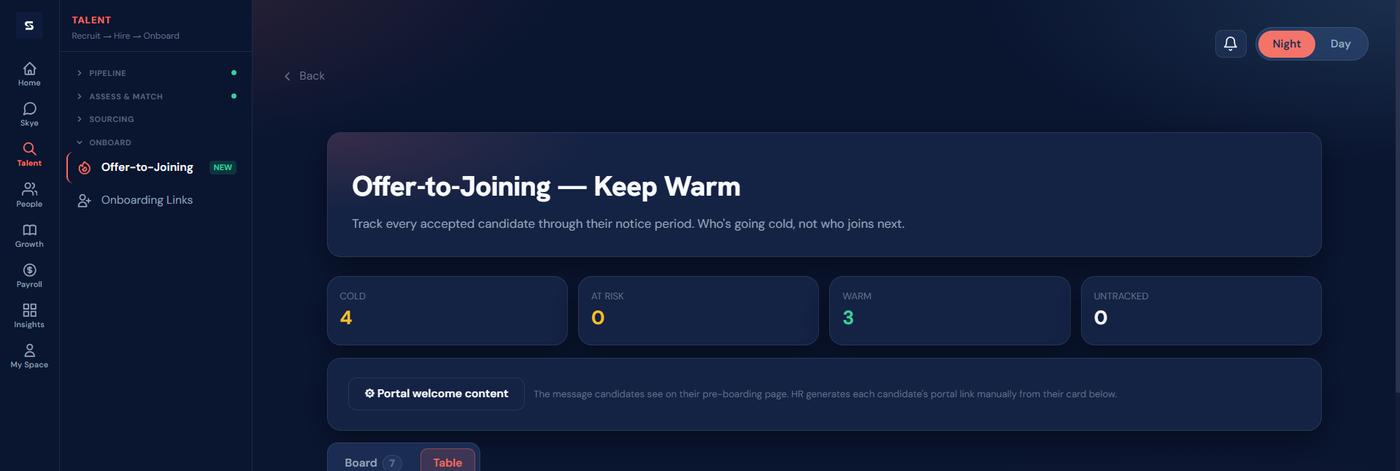
Offer-to-joining engagement tracker
Safeguards accepted offers during 30 to 90 day notice periods:
- Early risk detection. Flags hedging candidates, for example missing resignation proof or extended silence.
- Objective risk scoring. Categorizes candidates as WARM, AT RISK or COLD, prompting targeted HR interventions.
- Talent pool standby. Keeps backfill candidates engaged if a primary hire turns COLD, preventing zero-day hiring shocks.
Benchmark-based impact
The ranges below are directional industry benchmarks and target placeholders, not measured Bridgewell Advisory outcomes. As a design partnership, confirmed platform results will replace these figures as usage history builds. Benchmarks are aggregated from SHRM 2025 and public industry recruiting reports.
| Industry | Reported hiring benchmarks | Common hiring friction | SKILWI.ai directional target |
|---|---|---|---|
| Information Technology | Technology is among the slower sectors to fill, with time-to-hire commonly reported around 45 to 52 days and specialist roles extending well beyond that. Reported technology offer acceptance sits around 78% to 81%. | Niche skills, multiple technical interviews, competing offers, compensation expectations and longer evaluation loops. | Reduce hiring cycle time by 30% to 40%, reduce recruiter screening effort by 40% to 50%, and improve offer conversion toward 80% to 85% through AI screening, 5-signal matching and faster panel decisions. |
| Manufacturing | Manufacturing time-to-fill commonly runs about 18 to 35 days for production roles. Reported manufacturing offer acceptance is comparatively strong, around 82% to 92%. | Skilled-labor shortage, shift fit, maintenance capability, safety requirements, location constraints and reliability during notice periods. | Reduce time-to-fill by 20% to 30%, improve shortlisting speed by 7 to 10 days, reduce post-offer drop-off exposure by 25% to 35%, and maintain offer acceptance in the 85% to 90% range. |
| Pharma and Life Sciences | Pharma behaves closer to healthcare and regulated specialist hiring. Reported healthcare time-to-hire is around 44 to 49 days, with credential-dependent roles longer. Healthcare offer acceptance is reported around 77% to 85%. | Credential verification, domain specialization, regulatory knowledge, quality and compliance requirements and limited qualified talent pools. | Reduce hiring cycle time by 25% to 35%, improve qualified shortlist readiness by 10 to 15 days, reduce manual screening effort by 35% to 45%, and improve offer conversion toward 82% to 88%. |
| Cross-industry drop-off | Post-offer candidate loss is commonly reported at about 10% to 20%, driven by candidate silence, competing offers and slow feedback. | Candidate silence, competing offers, slow feedback, long notice periods and disengagement after acceptance. | Reduce post-offer drop-off exposure by 25% to 35% through resignation-proof tracking, weekly engagement, risk classification, recruiter alerts and backfill readiness. |
Sources: SHRM 2025 Talent Acquisition Benchmarking, plus aggregated public recruiting-metric reports. Figures are directional and vary by role, seniority, location and methodology.
Industry use cases
Information Technology: accelerating specialist hiring in a competitive market
For IT mandates with niche skills, multiple interview rounds and competing offers, SKILWI.ai helps recruiters move faster from resume screening to evidence-backed shortlisting by combining 5-signal matching, AI video screening, technical-fit evidence and structured panel feedback.
Expected value: faster shortlist readiness, lower screening effort, stronger technical-fit justification for clients, and improved offer conversion where top candidates weigh several opportunities at once.
Manufacturing: improving skilled hiring reliability and joining assurance
For skilled and operational roles where availability, location fit, shift readiness, safety awareness and joining reliability affect business continuity, recruiters use structured scorecards and TAT dashboards to spot slowing pipelines, while the keep-warm tracker monitors accepted candidates through notice periods.
Expected value: better visibility on skilled-role pipelines, reduced last-minute drop-off, faster backfill action, and higher confidence that accepted candidates join on the planned date.
Pharma and Life Sciences: evidence-based hiring for regulated roles
For roles where technical qualification, domain expertise, regulatory exposure, documentation discipline and compliance readiness are essential, SKILWI.ai lets recruiters present structured evidence on skill match, experience depth, behavioral fit and training needs instead of relying only on resume claims.
Expected value: clearer fit validation for specialized roles, stronger client confidence in regulated decisions, reduced manual screening, and better alignment between candidate capability, compliance and onboarding readiness.
Why it matters
Technology is valuable to an executive search firm only when it strengthens judgment, accelerates delivery and improves client confidence across role families. In IT, speed and technical fit are critical because candidates often hold multiple offers. In manufacturing, pipeline reliability and joining assurance protect production continuity. In pharma, evidence-backed selection is essential because qualification, compliance and domain expertise must be clearly demonstrated.
By combining explainable AI, behavioral assessment, consolidated scorecards, TAT visibility and offer-to-joining engagement, SKILWI.ai acts as a recruitment intelligence layer that adapts to sector-specific hiring challenges rather than offering a one-size-fits-all ATS workflow. The result is a more advisory-led search model, where recruiters move beyond resume summaries to present evidence-backed recommendations.
"SKILWI.ai does more than rank candidates. It shows us why a candidate fits, where the gaps are, and how confident we can be in the recommendation. That level of transparency changes the quality of our client conversations."

Co-founder, Bridgewell Advisory
Common questions
How does SKILWI.ai help executive search firms?
It adds a recruitment-intelligence layer across screening, skill matching, behavioral assessment, panel evaluation, turnaround-time tracking and offer-to-joining engagement, so recruiters shortlist on evidence and can explain why each candidate fits.
What is 5-signal explainable AI matching?
SKILWI.ai scores each candidate across five signals, skill match, semantic fit, experience depth, seniority level and educational background, and generates a written rationale for every score so recruiters can justify the shortlist to clients.
What is offer-to-joining (keep-warm) tracking?
It monitors every accepted candidate through the notice period, flagging drop-off risk and classifying each as WARM, AT RISK or COLD so recruiters can intervene before a joiner goes cold.
Is SKILWI.ai only for recruitment?
No. Recruitment is one module of the SKILWI.ai Workforce Intelligence OS. The same skill graph also powers skill-gap analysis, internal mobility, succession and a rupee-denominated hire-vs-upskill Decision Engine.
Which industries does the recruitment intelligence support?
It adapts to sector-specific hiring across Information Technology, Manufacturing, and Pharma and Life Sciences, among others, tuning matching and evaluation to each sector's constraints.
Make hiring faster, clearer and more transparent
See how SKILWI.ai helps your recruitment team build evidence-backed shortlists and protect offers until joining.
Request a demo